HVAC water filtration removes suspended solids, particulates, and organics to protect equipment, preserve thermal performance, and reduce public-health risks like Legionella. This article details automatic screen, disc, and granular media filters, covering their mechanisms, benefits, maintenance, and integration into comprehensive HVAC protection strategies.
Filtration prevents particulates from depositing on heat-exchange surfaces, preserving heat transfer and reducing energy use. Removing silt, rust, and organic load helps chillers and cooling towers maintain designed delta-T and reduce fouling. Effective filtration also limits biofilm formation, a key factor in Legionella amplification. These operational gains lead to fewer outages, lower cleaning costs, and simpler compliance.
Suspended solids, corrosion products, organic matter, algae, and scaling minerals damage HVAC systems. Coarse solids clog, fine particulates foul, dissolved minerals form scale, and corrosion products create sludge. Biofilm shelters pathogens. Tracking DP, turbidity, and delta-T shifts helps diagnose issues.
Clean surfaces and consistent flows preserve thermal gradients, reducing pump energy. Removing abrasive particles extends component life. Filtration yields significant energy savings and reduces aggressive chemical cleaning. It is integral to water treatment, preserving heat transfer, reducing energy use, and extending equipment life.
Primary HVAC filtration technologies include automatic self-cleaning screen, automatic disc, and granular media filters. Screen filters are for coarse prefiltration, disc filters for finer particles, and media filters for very fine particulates and organics. Selection depends on micron retention, flow capacity, and maintenance preferences. Changsha Dawning Environmental Protection Technology Co., Ltd. (Dawning Filtration System) supplies these product families and assists with specification-driven selection.
| Filter Type | Characteristic | Typical HVAC Application |
|---|---|---|
| Automatic Screen Filter | Surface filtration via woven or perforated mesh; automatic backwash | Prefiltration for cooling-tower make-up and closed-loop protection |
| Automatic Disc Filter | Stacked disc depth capture with self-cleaning cycles | Fine particulate control in cooling-tower basins and recirculating loops |
| Media Filter (Granular) | Depth filtration through graded media bed for polishing | Polishing for closed-loop chillers and high-quality recirculation circuits |
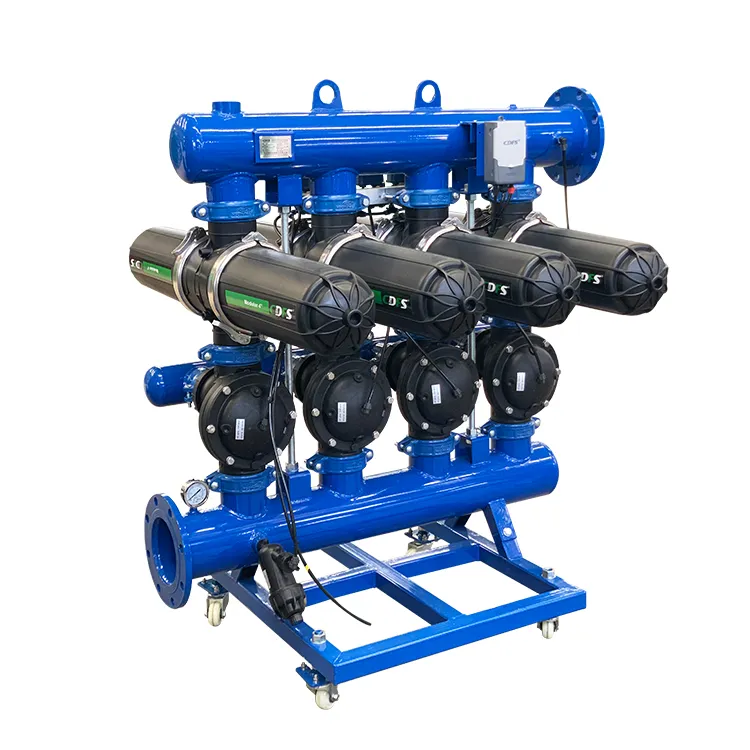
Automatic self-cleaning screen filters trap solids on a mesh, using differential pressure to trigger backwash. They remove coarse sediments, protect downstream equipment, and fit compact spaces, often serving as prefilters.
Automatic disc filters use grooved discs for fine particle capture and efficient backwash. Their modular design enables scalable capacity and redundancy. They maintain consistent micron performance, reduce blowdown frequency, and improve heat exchange.
Effective corrosion and scale prevention combines physical filtration, water-chemistry control, mechanical cleaning, and monitoring. Filtration removes particulates that seed scale and carry corrosion products. Water-chemistry control manages dissolved ions. Mechanical actions address deposits. Continuous monitoring enables timely corrective actions and lowers long-term costs.
| Issue | Preventive Strategy | Expected Outcome |
|---|---|---|
| Scale | Filtration + softening or scale inhibitors | Reduced deposition; restored heat transfer |
| Corrosion | Filtration + corrosion inhibitors + appropriate materials | Lower corrosion rates; fewer particulate corrosion byproducts |
| Biofilm | Filtration + disinfection + mechanical cleaning | Reduced microbial load; lower Legionella risk |
Control scale by prefiltering particulates, then applying targeted chemical treatment (inhibitors or softening). A tiered approach involves removing solids, monitoring conductivity, dosing inhibitors, and scheduling mechanical descaling. Limiting fine particulates reduces chemical demand.
Reducing biofilm through filtration, disinfection, and mechanical cleaning lowers Legionella risk. Filtration reduces organic load; periodic disinfection targets established biofilm. Regular monitoring paired with condition-based maintenance creates a surveillance loop. Integrated biofilm control preserves materials and heat-exchange efficiency.
Routine maintenance emphasizes condition-based inspection, control logic verification, and planned replacement of wear items. Monitor differential pressure, backwash counts, and turbidity as service triggers. Log operational data, stock critical spares, and validate performance. These measures ensure optimal filtration and support corrosion/biofilm control.
| Task | Frequency | Responsible Role |
|---|---|---|
| Differential pressure check | Daily to weekly (based on solids load) | Operations technician |
| Backwash sequence verification | Weekly to monthly | Maintenance engineer |
| Spare parts audit (seals/actuators) | Quarterly | Procurement / maintenance planner |
Frequency depends on source-water quality and filter technology. Condition-based triggers (DP rise, turbidity increase) are preferred. Screen filters may need daily/weekly checks; disc filters weeks/months; media filters seasonal inspection/replacement. Automated monitoring refines intervals.
Best practices for automatic self-cleaning filters include verifying control triggers, inspecting mechanisms and seals, and logging backwash frequency. Periodically test actuators and control panels, replacing consumables on a lifecycle schedule. Train staff on telemetry for timely responses. These practices preserve uptime.
Filtration solutions improve HVAC reliability across industrial manufacturing, data centers, hospitals, and municipal buildings by addressing site-specific challenges. Robust prefiltration reduces fouling in industrial plants; filtration supports microbial-risk reduction in hospitals. Municipal installations require resilience and low maintenance. Case summaries illustrate outcomes.
| Project Type | Challenge | Filtration Solution |
|---|---|---|
| Industrial plant | High silt in river make-up | Screen filter + media polishing |
| Municipal HVAC hub | Variable source water quality | Modular disc filters with remote monitoring |
| Commercial campus | Biofilm in recirculating loop | Media filter + coordinated disinfection program |
In industrial facilities, automatic screen filters remove coarse solids, preserving heat-exchanger performance. Downstream media or disc filters polish water, protecting chillers from fine-particle fouling. Layered solutions convert reactive cleaning into scheduled maintenance, improving uptime, lowering energy use, and providing predictable budgets.
Municipal HVAC hubs deploy modular disc filters, maintaining performance under fluctuating loads, enabling longer service intervals and remote diagnostics. These filters reduce basin cleaning frequency and biocide demand. Operators benefit from staged scalability and remote monitoring, highlighting the value of robust filtration.
Designing tailored HVAC filtration begins with source-water characterization, micron retention, flow profiles, pressure drop, and backwash handling. Integration steps include site assessment, pilot testing, detailed sizing, control-logic specification, BMS integration, and structured commissioning. Effective integration relies on vendor engineering support, reducing rework and accelerating reliable operation.
| Design Factor | Consideration | Impact on Selection |
|---|---|---|
| Flow rate | Peak and average flow needs | Determines module count and sizing |
| Micron requirement | Target particle size to remove | Drives choice of screen, disc or media |
| Backwash handling | Waste volume and disposal | Affects filter automation and plumbing |
Key design inputs include source-water characterization, system flow profiles, allowable pressure-drop, and required micron performance. Redundancy, bypass arrangements, and backwash-water handling also influence design. Pilot testing validates assumptions, enabling accurate module counts, control logic, and spare-parts planning. Prioritizing these factors reduces commissioning surprises.
Vendor engineering support—including specification review, P&ID inputs, control-logic templates, onsite commissioning, and operator training—reduces integration time and performance risk. Suppliers provide essential deliverables for handover and total cost of ownership evaluation. Onsite startup and training ensure proper implementation of control sequences.
Sustained DP rise, increased turbidity, reduced system flow, or unusual noises indicate maintenance is needed. Consistent monitoring allows timely intervention.
Integrate filter controls with the BMS for real-time monitoring, alarms, and automated sequences. Map I/O, align control logic, and enable remote diagnostics for condition-based maintenance.
Water chemistry affects contaminant behavior and filtration performance. Managing chemistry reduces load on filters and extends service life.
Advanced filtration improves energy efficiency, lowering power use and emissions. It also reduces water and chemical waste, supporting compliance and sustainability.
Automatic screen filters require less hands-on maintenance; disc filters need maintenance tied to backwash cycles; media filters require periodic media replacement. Choose technology based on operational capacity.


 EN
EN
 FR
FR
 NL
NL
 RU
RU
 AR
AR
 VI
VI
 LO
LO
 RO
RO
 TH
TH
 MY
MY
 MS
MS
 PT
PT
 ES
ES
 KO
KO
 BE
BE
 JA
JA
 FIL
FIL
 KA
KA
 DE
DE
 IT
IT

