Scale, suspended solids, and biological fouling in HVAC water loops significantly reduce heat transfer and increase energy consumption. Targeted filtration, correctly sized and applied, can restore thermal performance and cut energy use substantially. This article explains how deposits degrade thermal equipment and introduces effective filtration technologies—automatic screen, disc, and media filters. It covers their operation, optimal placement in cooling towers, chillers, and condenser loops, and how to evaluate ROI and plan implementation. Practical guidance, case datapoints, and a procurement checklist are provided to help professionals implement filtration strategies that protect exchangers, reduce chemical cleaning, and lower energy and maintenance costs.
Scale and fouling, comprising mineral deposits, suspended solids, and biofilms, form on wetted surfaces within HVAC water circuits. These layers increase thermal resistance, restrict flow, and raise pressure drop, directly reducing heat transfer and increasing pump and fan energy. Even thin deposits force equipment to run longer or at higher differential pressures, increasing electricity use. Engineering studies show modest fouling can increase chiller energy consumption by double-digit percentages, also accelerating maintenance and shortening equipment life.
Deposits originate from suspended solids, hardness minerals (calcium, magnesium), corrosion products, and organic loads from make-up water or system components. Poor operational practices—such as low bleed rates, insufficient side-stream filtration, and irregular blowdown—concentrate particulates and minerals, leading to nucleation and deposition. Biofilms thrive in nutrient-rich, stagnant zones, trapping additional solids. Particles range from silt and rust flakes (tens to hundreds of microns) to colloidal fines, requiring various filtration methods.
On heat-exchange surfaces, deposits act as insulating layers, demanding more energy for the same heat transfer. Blocked passages and roughened surfaces increase frictional losses and pump work. Even micrometer-scale films degrade heat-transfer coefficients, while millimeter-scale fouling often necessitates higher chilled-water supply temperatures or longer runtimes, increasing kWh use. Uneven flow also raises localized corrosion risk and hotspots. Preventive filtration keeps surfaces clean, preserving design approach temperatures and reducing unnecessary pump and compressor cycling, directly lowering energy bills.
Automatic self-cleaning filters are in-line or side-stream devices that remove suspended solids from circulating water, periodically discharging collected debris without disassembly. They use differential-pressure triggers or timed cycles for cleaning, maintaining a stable, low pressure-drop profile and continuous protection for heat-transfer surfaces. These filters reduce manual cleaning and intensive chemical cleanouts by trapping abrasive and fouling particles before they reach exchangers, preserving thermal performance and cutting pump energy.
In HVAC, they primarily protect cooling towers, condenser loops, and chiller side-streams, ensuring consistent heat transfer and fewer emergency shutdowns.
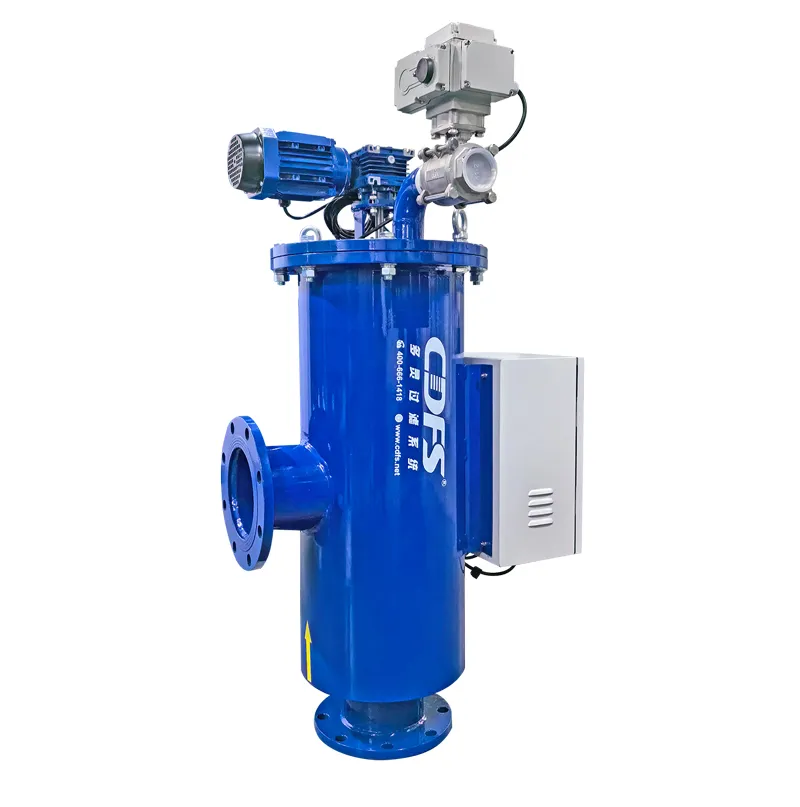
Automatic screen filters use metal woven mesh or perforated screens to capture particles. An electric brush or backwashing mechanism cleans the screen online, discharging contaminants directly through a drain outlet.
The filtration accuracy can be flexibly configured based on the screen type, typically covering a range of 20–4000 microns, making them suitable for both coarse particle removal and finer pre-filtration applications.
These filters are commonly used in cooling tower side-stream systems or main circulation pipelines to:
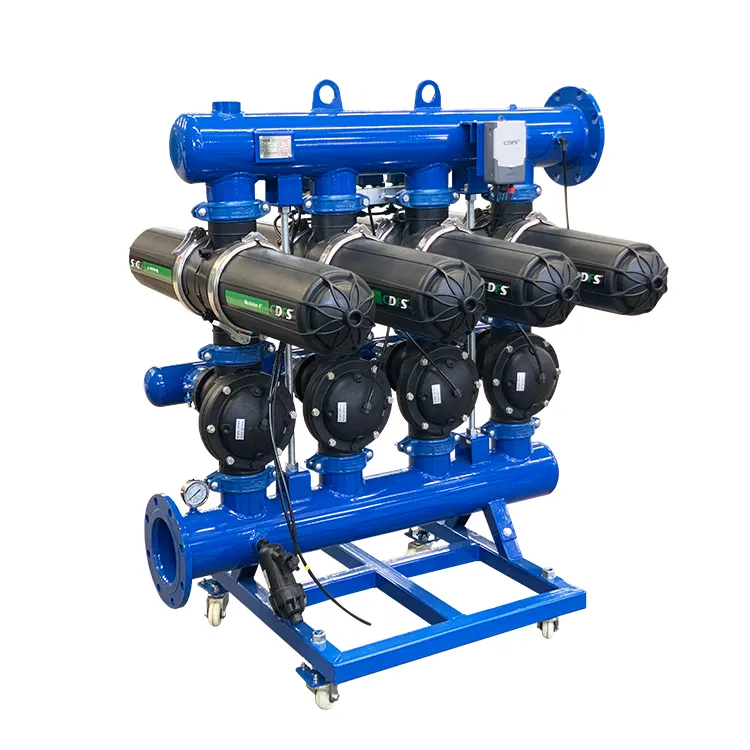
Automatic disc filters consist of multiple stacked discs that capture particles through the fine grooves and channels on the disc surfaces.
When the system differential pressure reaches a preset value, the filter automatically initiates a backwash cycle, using reverse water flow to flush out solids trapped between the discs and discharge them from the system.
Typical filtration accuracy ranges from 20–4000 microns, with the following advantages:
Both types of filters can maintain low system pressure loss during operation, which helps to preserve high heat-transfer efficiency, reduce circulating pump power consumption, Indirectly lower the overall energy use of compressors and chillers.
| Filter Type | Cleaning Method | Typical Filtration Accuracy | Maintenance Frequency |
|---|---|---|---|
| Automatic Screen Filter | Electric brushing / Backwashing | 20–4000 μm | Low to moderate; automatic cleaning greatly reduces manual intervention |
| Automatic Disc Filter | Automatic backwashing | 20–4000 μm | Moderate; suitable for high particle-load conditions |
We manufactures automatic screen and disc filters, offering customization to match specific HVAC flows and control requirements. Their products integrate with differential-pressure controls and automated purge piping, simplifying commissioning. Datasheets, sizing guidance, and lifecycle projections are available for site evaluation.
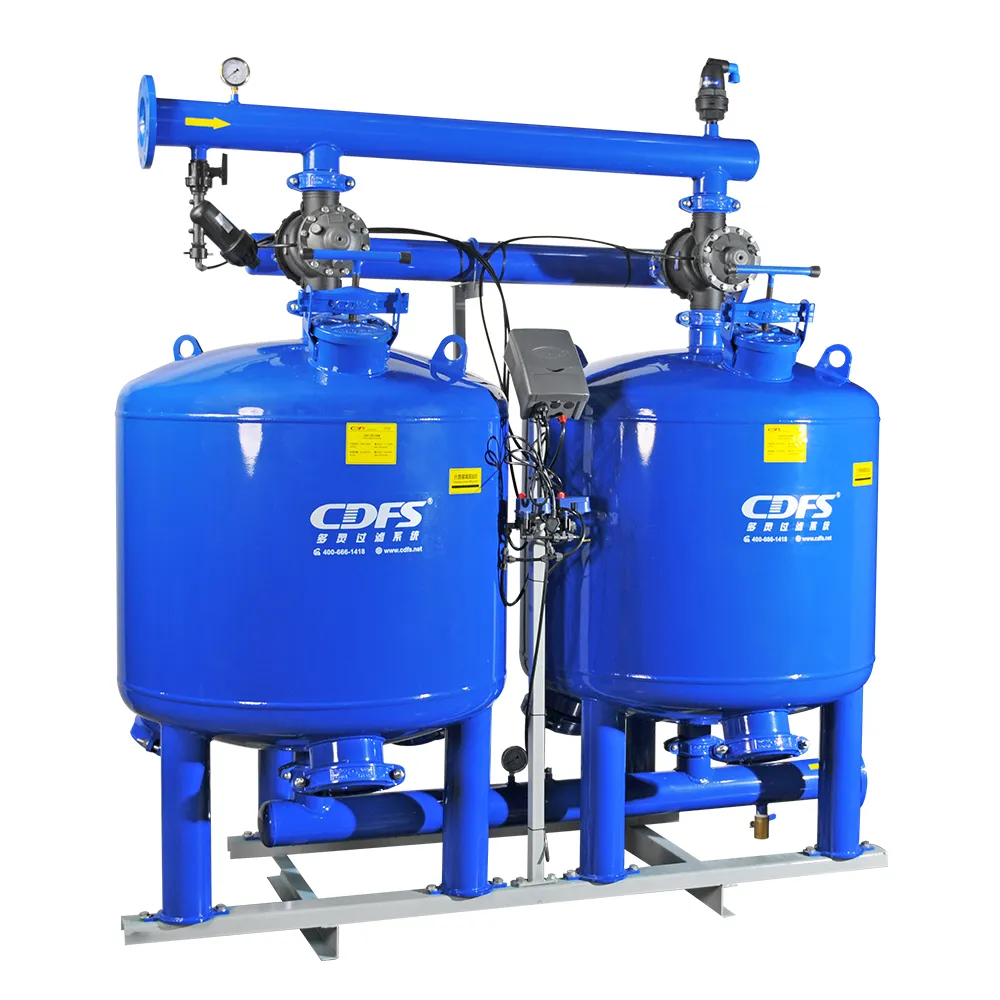
Media filters, including multimedia beds, use layered media to capture a wide range of particle sizes through depth filtration, excelling at removing fine suspended solids and turbidity that bypass coarse self-cleaning devices. Used in side-stream polishers or basin make-up treatment, media filters reduce the load on exchangers, limiting deposit formation that degrades thermal transfer and supports microbial growth. These systems also reduce reliance on frequent chemical cleanings by periodically backwashing trapped fines, lowering chemical dosage and wastewater volumes.
Media filters remove fines by forcing water through layers of different media sizes (e.g., anthracite, silica sand, or activated carbon), retaining particles within the bed for high capture efficiency of approximately 10–50 microns and larger.
In HVAC, they are often deployed as side-stream polishers (typically 5–20% of system flow) to continuously remove fines, protecting chillers and condenser coils from microfouling and silt. By trapping fines before they abrade or adhere to exchanger surfaces, media filtration extends service intervals, lowers downtime, and reduces chemical consumption for descaling and biofilm control, improving total cost of ownership.
| Media Configuration | Particle Capture Range | Backwash Requirement | Typical HVAC Applications |
|---|---|---|---|
| Anthracite + Sand | 10–200 μm | Moderate, periodic | Circulating water quality improvement, cooling tower basins |
| Sand + Garnet | 5–100 μm | Moderate to higher | Finer polishing for chillers |
| Activated Carbon / Specialized bed | <10–100 μm plus organics | Higher; periodic | Organics control and fine solids removal |
Filtration delivers the highest value where water-side heat transfer is critical: cooling towers, chillers, condenser loops, and plate-and-shell heat exchangers. Systems with variable make-up water or legacy piping benefit significantly. Side-stream polishing is a cost-effective architecture for protecting critical exchangers.
By keeping heat-exchange surfaces clean, filtration allows cooling towers to maintain approach temperature targets and chillers to operate at designed delta-T values, reducing runtime and compressor staging. Preventing sediment in basins and condenser paths lowers biological hotspots and stabilizes thermal transfer, often enabling lower condenser-water temperatures and reduced chilled-water setpoints. Cleaner loops also reduce pump energy through lower friction losses. Effective filtration minimizes localized fouling, corrosion, and uneven flow in condenser tubes and plate exchangers, reducing tube failure risk and extending maintenance intervals. A stable, low pressure drop across exchangers keeps pumps operating efficiently, cutting electrical consumption and wear, while also making chemical treatment more predictable.
The 30% improvement range reflects combined benefits: restored heat-transfer coefficients, reduced pump head, and stabilized control cycles after filtration retrofit, documented in projects where baseline fouling was significant. Measurement methods include before/after energy monitoring of chilled-water compressors and pumps (kWh), alongside fouling indices and maintenance logs. Conservatively, this p represents upper-range outcomes in heavily fouled systems; typical gains in moderately fouled systems are commonly 10–20%.
Filtration lowers costs across energy (improved heat transfer, reduced pump/compressor load), labor (fewer manual cleanings, emergency interventions), chemicals (less frequent descaling, biocide shocks), and downtime (fewer unplanned outages). Conservative payback models comparing filtration capital and O&M against annualized savings commonly fall within 1–4 years, depending on site specifics. Capturing site flow data, particulate loading, and current maintenance cycles enables precise financial modeling, often showing filtration as a high-impact, low-disruption investment.
Implementation follows a four-phase path:
Site assessment (baseline measurements, water sampling);
Solution selection (filter type, micron rating, placement);
Integration and control (differential-pressure sensors, purge piping, automation); Commissioning with monitored performance verification.
Customization options include filter materials (stainless grades), element micron ratings, purge valve arrangements, automation protocols (differential-pressure triggers, remote alarms), and skid integration for compact footprints. Manufacturers often provide control logic to match existing BMS networks. Procurement teams should supply baseline site data—nominal flow rates, peak turndown, influent particulate levels, and piping layouts—to shorten design cycles and ensure accurate sizing.
To request technical documents and proposals from Dawning, provide a concise submission: site type, nominal and peak flow rates, known particulate or hardness issues, primary objectives (energy, maintenance reduction, water savings), and timeline for implementation. This accelerates quotation and technical validation, streamlining the procurement cycle.
1.What is the reason behind HVAC systems getting higher energy consumption due to scale and fouling?
Scale and fouling create a situation described by insulating layers on heat-exchange surfaces which consequently cause an increase in thermal resistance and the reduction of heat-transfer efficiency. On top of that, they limit water flow and increase pressure drop in the system, and thus pumps and compressors have to work harder which results in a significant increase in electricity consumption.
2.What are some benefits that automatic self-cleaning filters offer in comparison to traditional filters?
Automatic self-cleaning filters can take off the debris they have captured during the operation of a system without the need for a shutdown or disassembly of the system. They provide a constantly low pressure drop which is stable and non-oscillating, thus protecting heat-transfer equipment continuously, and also reducing the need for manually conducted maintenance and chemical cleaning, which results in improved overall system efficiency and also lowered operating costs.
3.What function do media filters perform in HVAC systems mainly?
Media filters are designed to work with layered filtration media which trap the fine suspended particles and turbidity that most usually get through the coarse filters. Fine particles are responsible for microfouling and heat-transfer degradation to a large extent. Media filtration can prolong maintenance intervals and cut down chemical consumption.
4.What HVAC applications can take the most advantage of energy-saving filtration systems?
Cooling towers, chillers, condenser loops, and plate or shell-and-tube heat exchangers are the applications that most benefit, especially in systems with variable make-up water quality or aging piping where filtration results in the greatest savings in energy and maintenance.
5.What is the typical time frame for coming back the investment in an energy-saving filtration system?
Depending on the conditions of the site, the payback period usually ranges from 1 to 4 years. The money saved comes from the reductions in energy consumption, the cutback in maintenance labor, and so on.


 EN
EN
 FR
FR
 NL
NL
 RU
RU
 AR
AR
 VI
VI
 LO
LO
 RO
RO
 TH
TH
 MY
MY
 MS
MS
 PT
PT
 ES
ES
 KO
KO
 BE
BE
 JA
JA
 FIL
FIL
 KA
KA
 DE
DE
 IT
IT

