Disc filters rely on stacked, grooved discs that create a labyrinth of filtration layers, capturing particles between 50 and 500μm with exceptional accuracy. Water passes through these interlocking grooves, where impurities lodge securely, allowing clean filtrate to proceed. This design excels in handling high sediment loads without frequent clogging.
Compared to traditional screen or sand filters, automatic disc filters offer superior advantages. They maintain low pressure drops, typically under 0.2 bar during operation, preserving pump energy. Equipment like pumps and valves lasts longer due to reduced wear from cleaner water, often extending service life by 2-3 times in harsh conditions.
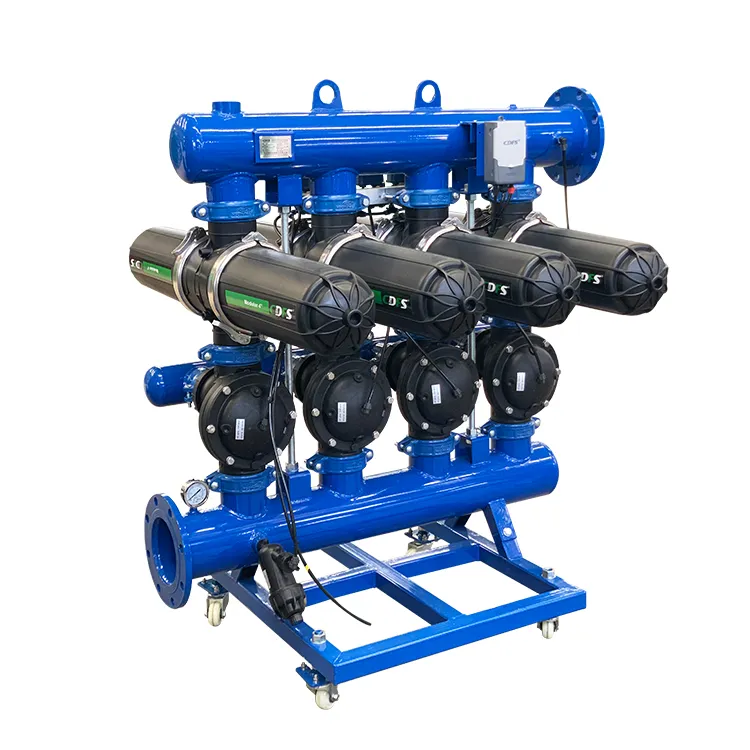
Automatic backwash disc filter systems detect rising differential pressure via sensors, triggering a brief reverse flow to spin discs apart and flush debris. This process, lasting mere seconds, uses less than 1% of filtered volume, minimizing waste. CDFS models integrate PLC controls for precise timing, adaptable to varying conditions.
In practice, suction nozzles or high-velocity jets dislodge solids during backwash, directing them to drain without interrupting main flow. Such automation ensures 24/7 uptime, critical for continuous operations. Energy efficiency stems from infrequent cycles, often every 24-48 hours under normal loads.
Drip irrigation demands pristine water to prevent emitter blockages, where automatic disc filters shine by removing algae, sand, and organic matter at 50-130μm. Farmers report 20-30% yield increases from consistent distribution. Spray systems similarly benefit, avoiding nozzle wear in pivot setups.
In regions with turbid sources like rivers, these filters handle peak flows up to 500m³/h, supporting large orchards or fields.
Cooling towers accumulate scale and biofouling rapidly; automatic self-cleaning water filters at 100-200μm intercept these threats early. Enhanced heat exchange follows, cutting energy costs by 15%. HVAC systems gain longevity, with chillers operating below fouling thresholds.
Municipal or industrial pretreatment uses disc filters to precondition water, stabilizing pH and turbidity for downstream RO or UF membranes. Safety improves as consistent quality reduces contamination risks in food processing or pharma plants.
Proper cleaning cycles in automatic backwash disc filters underpin system stability, preventing bypass flows that spike energy use. Maintenance costs drop 40-60% versus manual methods, as labor and downtime vanish. Automated cycles align with actual fouling rates, avoiding premature wear.
Manual cleaning exposes workers to hazards and risks incomplete debris removal, often leading to bacterial growth. In contrast, backwash delivers thorough results, restoring 95%+ of original capacity each time.
Frequency adjustment via water quality sensors optimizes performance—daily in high-turbidity scenarios, weekly in cleaner supplies.
Elevated suspended solids, common in agricultural runoff, necessitate shorter cycles to uphold filtration precision in automatic disc filters. Lab tests show cycles every 4-6 hours suffice for 500mg/L loads, balancing cleanliness and consumption.
Differential pressure thresholds (0.3-0.5 bar) signal backwash in most systems, paired with flow meters for holistic monitoring. Programmable logic controllers (PLCs) log data, enabling predictive adjustments.
Summer heat boosts algae in ag systems, demanding adaptive cycles; winter lows allow extension. Industrial peaks during production ramps similarly require dynamic tuning for reliability.
The disc filters by CDFS feature automatic operation and come in a single-unit flow capacity that can vary from around 19 m³/h up to 2,000 m³/h, informed by the combined size, module choice, and operational conditions of the filter. The filtration rating has a wide area of 20 to 4,000 microns, where the 50–500 micron is the most frequently used for industrial and agricultural systems.
CDFS has a very flexible configuration for their disc filters. They can be based on pipe diameter, number of disc modules, and filtration precision, thus allowing custom design for specific site requirements. The automatic models are equipped with self-cleaning backwash functionality and IP65-rated automatic control systems, which in turn facilitate unattended operation and integration into modern water management systems.
| Application Area | Typical Flow Range (m³/h) | Filtration Rating (μm) | Key Features | Proven Benefits |
|---|---|---|---|---|
| Agricultural Irrigation (Drip & Spray) | 20–200 | 50–130 | Automatic backwash, depth filtration | Prevents emitter and nozzle clogging, improves irrigation uniformity |
| Cooling Tower Circulation Water | 100–500 | 100–200 | Self-cleaning, low pressure loss | Reduces scaling and biofouling, improves heat transfer efficiency |
| HVAC Circulating Systems | 200–800 | 50–500 | High flow handling capability | Extends equipment service life, stabilizes system water quality |
| Industrial Circulating & High-Solids Applications | 500–2,000 | 50–400 | Modular, parallel-expandable design | Supports large-scale industrial water circulation with reduced maintenance |
Note: Final configuration parameters should be optimized based on raw water quality, suspended solids concentration, and specific project design conditions.
Integrating an automatic self-cleaning water filter revolutionizes water management, delivering unmatched efficiency and uptime. Tailored CDFS solutions address specific flow, quality, and regulatory needs for merchants worldwide. Reach out for consultations on customized automatic disc filter deployments to elevate your offerings.
Sensors detect pressure rises or timers elapse, prompting efficient cleaning.
They recycle minimal flush volumes, often under 0.5% of throughput.
Affirmative; adjustable parameters handle fluctuations seamlessly.
130-200μm balances debris capture and flow in automatic disc filters.
Assess flow rate, particle profile, and backwash infrastructure first.



 EN
EN
 FR
FR
 NL
NL
 RU
RU
 AR
AR
 VI
VI
 LO
LO
 RO
RO
 TH
TH
 MY
MY
 MS
MS
 PT
PT
 ES
ES
 KO
KO
 BE
BE
 JA
JA
 FIL
FIL
 KA
KA
 DE
DE
 IT
IT

